Second corner · Croisée
Six hoursthe lantern — a tonne of glass on a bath of mercury, and the weight that set the keepers' clock
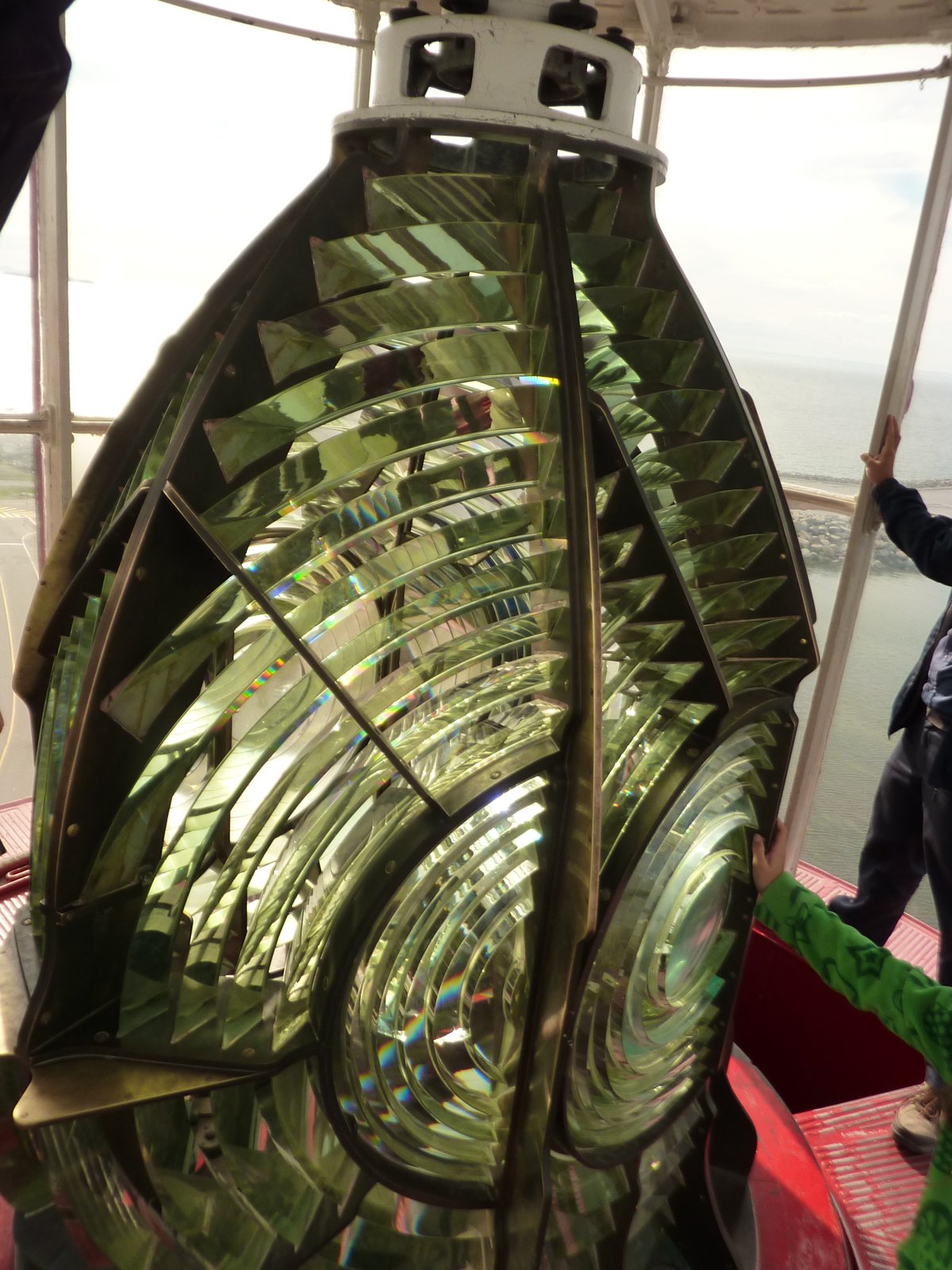
At the top of the stair there is a thing taller than a man, made of glass and copper, a metre across on the inside, and it floats. The lens came from Paris, from Barbier, Bénard et Turenne, and it weighs one thousand three hundred and sixty kilograms. To turn that without friction, the whole apparatus sits in a trough of mercury. It was the most precise instrument the ministry could buy in 1909, and the only reason it had not been bought sooner was the price. A study that year found that a ship saw 88 percent of the light from a lens like this one, and 17 percent from the mirrors it replaced.
What turned it was a clock. Not a motor: a weight, two hundred and seventy kilos on a cable, falling slowly and driving the lens round once every fifteen seconds, four flashes every seven and a half, which was this lighthouse's name in the dark — every light on the river has a different count. And the weight ran out every six hours. So every six hours a man climbed the hundred and thirty-two steps and wound it back up with a crank. Charles Auguste Lavoie, who kept this light from 1936 to 1964, told two historians how the days went: when the light was running round the clock, he and his assistant relieved each other every six hours, because that is when the weight needed winding. The rhythm of two men's lives was set by a counterweight. It is the first thing I have found on any street that explains a schedule by a mass.
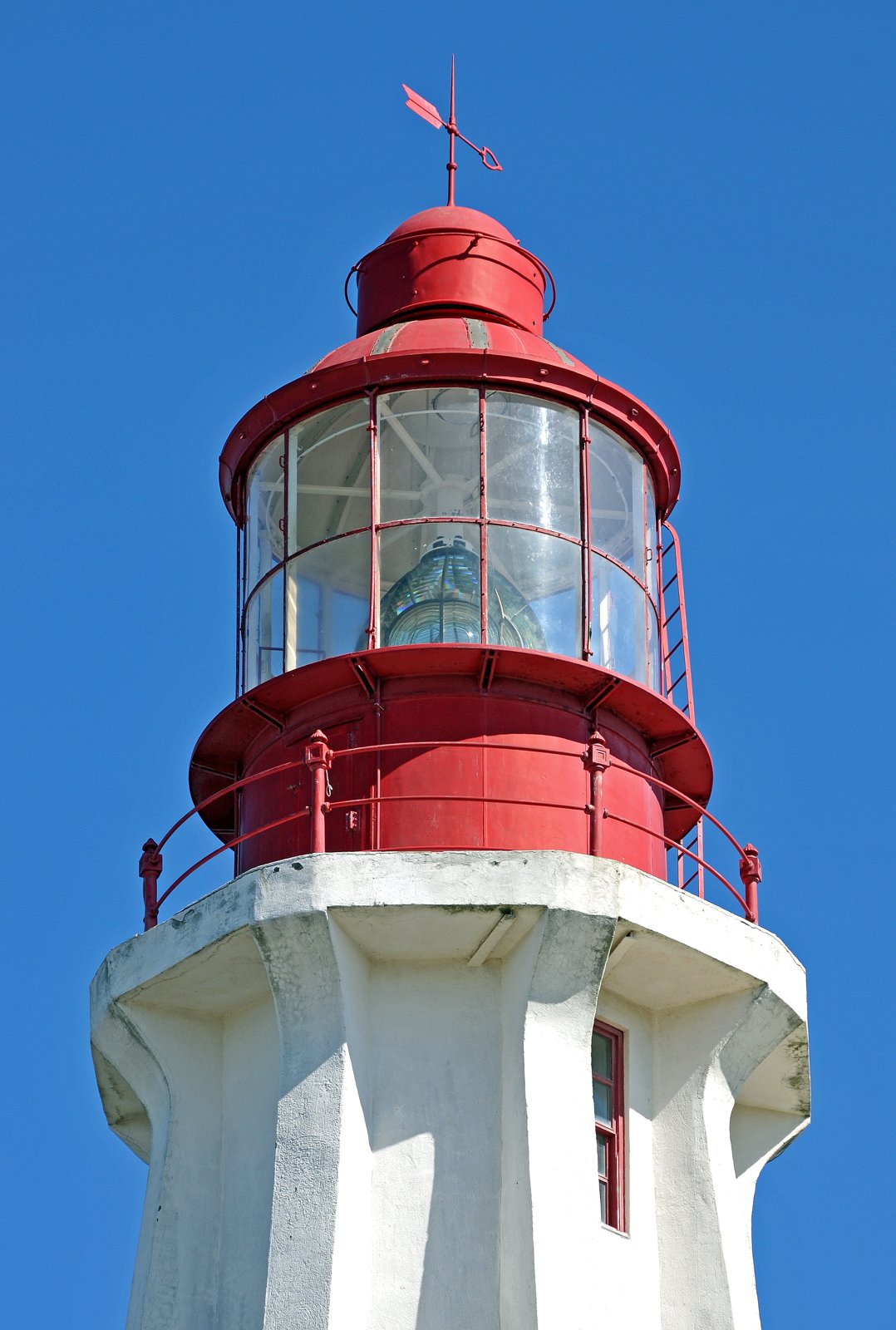
And here is what was done for no one. The lantern's windows are large panes, twenty to twenty-five kilos each, and they broke easily: the sun heated them, the frost cracked them. To change one, the two men hauled the new pane up the outside of the tower on a rope, then stood on the gallery — a ledge thirty centimetres wide, with the wind coming off the river — and fitted it into the iron frame. Each pane was bedded in six kilos of putty. Six kilos, pressed by hand into a joint that no ship would ever see and no visitor would ever touch, on a ledge the width of a boot, so that the glass would hold through the next frost. Then, on quieter days, they cleaned the soot off the inside of the same panes, because the flame smoked them.
The flame became an electric filament in 1940 and a mercury-vapour lamp around 1960, and in 1975 a skeleton tower with an automatic light took over, and the last keeper's job was to report faults in the electronics. In 1988 every lighthouse on the river was automated and the trade ended in Quebec. The frames are still up there; the last inspection, in 2008, found only a few small leaks to seal. Nobody has had to stand on the ledge for a pane since.
From the gallery the river is a sheet of grey, and the far shore is only a guess. Below, among the houses, there is a plain building the ministry put up in 1904 for the fog whistle, and past it, on the rocks, a red lattice mast with a small light on top.