First corner · Croisée
Nine inches above the sandthe causeway, a mile and a half of it — a boy, a fleet of taxis, and a carpet
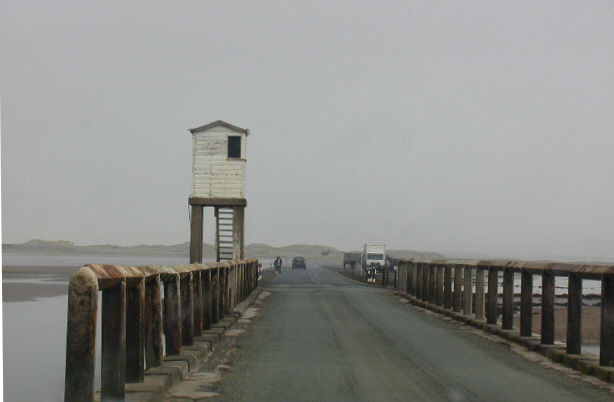
The best guide to this road is a highway engineer named J. Michael Taylor, who first saw it as a boy and then spent his working life keeping it alive. In 1953 his parents took him on a day trip from Seahouses. His father parked on the shore and negotiated a fare with one of what looked, to a young boy, like a vast fleet of rusty black cars that served as the island's taxis. Between them and the island stood a forest of poles forming random patterns across the sandbanks. They set off following one line of them. There was, he remembers, more rust inside the taxis than outside, and you had to watch your feet as the water rose into the car.
Out on the sand that day they passed cranes, bulldozers and men. His father told him they were building a road. It opened in 1954, and the taxis were finished. The men who built it worked in shifts set by the tide, in a cold winter wind, Taylor writes, un-moderated all the way from Norway.
The road you are on is a mile and a half long and about eighteen feet wide. It was laid nine inches above the sand, about the span of an open hand. At high tide it lies under four to six feet of sea, more in a storm. It is dry for about seven hours between one high water and the next. In 1965 it was extended so that the whole three miles from the mainland shore to the village is paved.
Here is the part I did not expect. Nine inches turned out to be wise. Every time a resurfacing raised the road above that height, the next winter storm put it back. The sea rolls the additional road surface up just like a carpet and deposits it to the carriageway edge. The sea has an opinion about how high this road may be, and it has never lost the argument. The method that works, Taylor says, is regular patching, scheduled around the tide and the weather. Not a better road. A road kept at the height the sea will allow.
And after every high tide the road has to be cleared of what the sea left on it: sand, which for environmental reasons is not taken off the island, and seaweed, sometimes in such heaps after a winter storm that clearing it is more like ploughing snow than sweeping a street. In very cold winters, he adds, parts of the sea here have frozen.
Taylor's article is a short personal memoir published by the Chartered Institution of Highways & Transportation. The last time he drove out, on a dark February day, the island and three castles, Lindisfarne, Bamburgh and Dunstanburgh, came up out of the spray, and he thought how privileged he was to see that as part of his daily work. I believe him.
Just under half a mile out, the road rises a little and passes over something you hardly notice. On your left, a small white hut stands on four posts, high above the road, with a stair of wooden steps going up to a door.