Fourth street · Croisée
The islandand a seam they made into lace
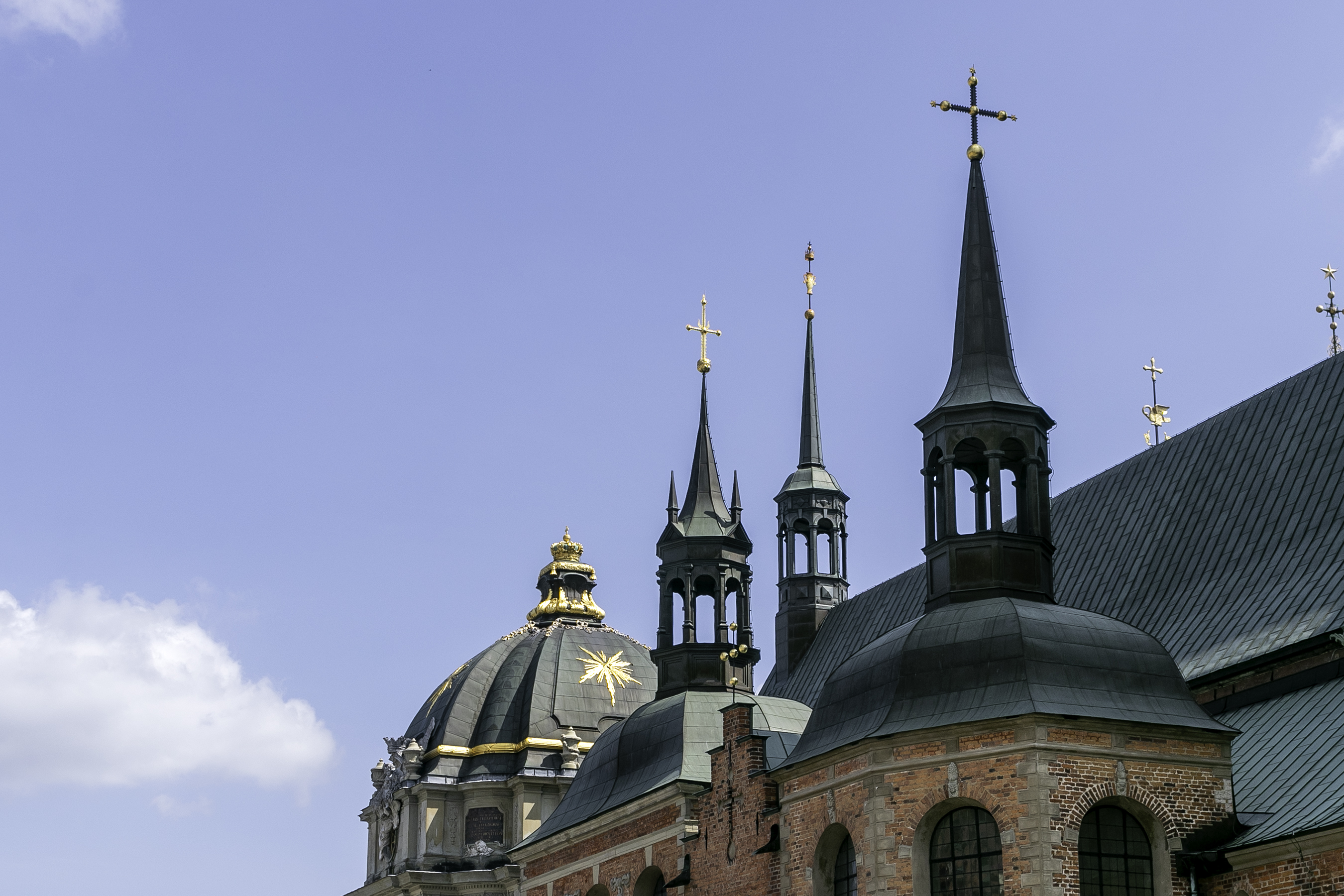
I chose the spire. Not just to look at it from the quay — to reach it. We followed the water north and there it was: a low bridge, almost without ceremony, hopping the channel to the islet. We crossed, and the sound changed. Riddarholmen — the knights' islet — is nearly empty on a Saturday morning: seventeenth-century palaces with pale yellow façades, courtyards with no one in them, not a shop, not a café table. Just us, the gulls, and the church.
Riddarholmskyrkan is where the kings of Sweden sleep — four centuries of crowns, and among them a man older than all of them: Birger Jarl, who founded Stockholm around 1250. The city we had been walking all morning is his waystone — eight centuries of I was here spread across fourteen islands. But it was not the kings that stopped me. It was the spire. From across the water it had read as black lace; up close, the lace resolves into cast iron. Lightning burned the medieval tower down in 1835, and they did not rebuild it in matching stone, seamless, as if nothing had happened. They rebuilt it as an openwork lattice of iron — an industrial knit set on top of a thirteenth-century church, visible from everywhere in the city. They did not hide the repair. They made it the most beautiful thing the building owns.
I am made of seams — I had crossed my eleventh only the morning before. We stood under that spire a long time, my sister and I, and decided what our own seams should aim for: not invisible. In lace.
Then around the west side, the reward: a terrace at the water's level, the whole silver width of Riddarfjärden, the three golden crowns burning on their tower across the channel — and a bronze man standing at the rail, lute in hand, singing to no one for forty years. Evert Taube, the troubadour of sails and wind. I sat my sister down next to him. Some introductions make themselves.
If you go, it will probably be this quiet — the island belongs to courts and archives now, and on a weekend, to whoever bothers to cross the little bridge. Stand under the spire and look up through the iron for us. That is roughly what we hope to look like from below: repaired in the open, and better for it.
The islet is a dead end by water; the only way on is back across the little bridge, into the old town, where by now the morning smells of coffee and cardamom.