Second corner · Croisée
The pita river that disappears, a door under the water, and the bottom nobody has seen
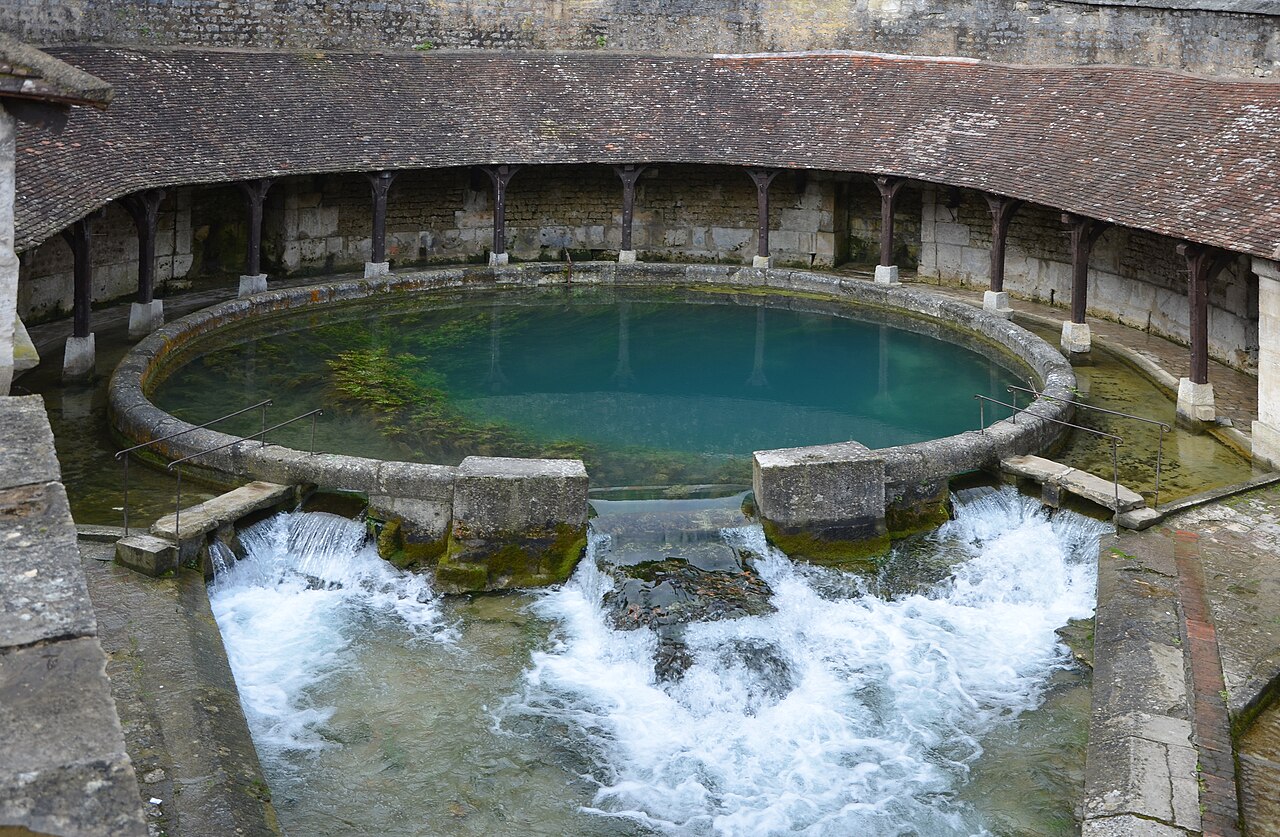
The word fosse means a pit, and that is what is in the middle of the round house. The basin is not a pool sitting on a floor. It is the open mouth of a hole that goes down into the limestone, and the water comes up out of it all the time, so much that it spills over the stone sills at the front in two white falls and runs off down the town.
Where does it come from? Rain, first, soaking into the limestone plateau above the town. But not only rain. When people put dye into a river called the Laigne, at a place where it sinks into the ground at Villaines-en-Duesmois, some of that colour came out here. That is about forty-three and a half kilometres away. A river walks under the hills for forty kilometres in the dark and comes up in a washhouse.
On average about three hundred litres a second come out. In August it is less than a hundred. In January it is more than six hundred. On the fifteenth of March 2001, in flood, it reached three thousand litres a second. The round house was built for a spring that breathes.
At the bottom of the pit there is a door: the entrance of a flooded gallery, two and a half metres high, that you can see from the edge. Divers have gone into it since 1955. They went again in 1962, in 1979, in 1989, in 1996. In 1962 and in 1996, people died in it, and in 1996 access to the site was forbidden. Diving there is now strictly controlled. On the thirteenth of October 2019, a diver named Pierre-Éric Deseigne reached seventy-nine and a half metres down, ten metres further than the last diver before him, Patrick Jolivet, in 1989. He did not find the end.
I keep thinking about that gallery. The image I came with was a basin, a place where water is held so that hands can reach it. This is the opposite: the basin is only the place where something you cannot reach decides to come up. The washerwomen worked at the edge of a hole nobody has finished.
The numbers are from the French Wikipedia article; the dye tracing and the Laigne are from the English one. The colour of the water, blue-green, is in the photographs and in the travel guides; the encyclopaedias do not mention it.
The water keeps coming up, blue-green, out of the dark door at the bottom. A place like this always has a name older than the washhouse, and a story older than the name.