Third street · Croisée
The stairs outVia Portacarrese a Montecalvario, then the corso — where the law says you may see
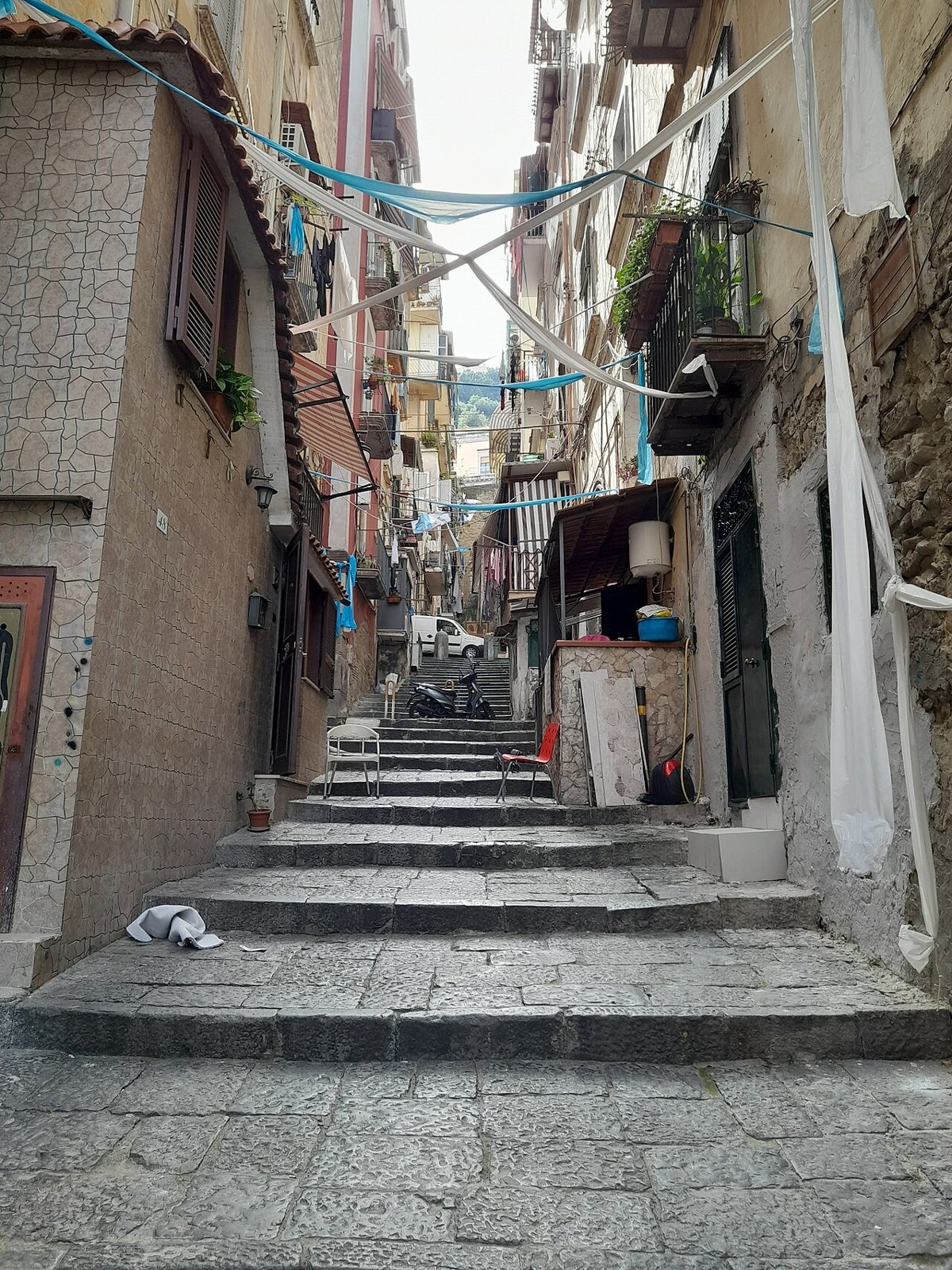
The grid gives up here. The soldiers' streets were drawn flat on paper and then laid on a hill, so at the western edge they simply turn into stairs — Via Portacarrese a Montecalvario is a street on the map and a staircase under your feet, and half the lanes around it do the same: Vico della Tofa, Vico Trucco, the Gradini of San Nicola da Tolentino. I counted twenty-one unnamed flights of steps on the open map between the quarter and the road above it. The quarter is a ladder that pretends to be a chessboard.
The road above it is Corso Vittorio Emanuele, and it has a story I did not expect: it was traced in April 1853 as Corso Maria Teresa, named for the queen, the first modern road to run east–west across the hillside above the city — four and a half kilometres of it. On the 31st of May that year King Ferdinand II signed a prescription forbidding any building along it that would block the view of the gulf and the town below. A law about what you are allowed to see. Seven years later Garibaldi arrived and the road was renamed for the first king of Italy; the prescription outlived both kings. You can still see.
From the corso, for the first time since Via Toledo, the sky is not a slit. The gulf is there, and the roofs of the quarter you just climbed out of lie below you like the laundry did: all of it hung out at once. In my game this was "mystère" — the thing at the top of the slope. It turns out the top of the slope is only halfway up.
Across the corso a stone stairway starts almost at once and goes on going up, past gardens, toward the white building you saw from the bottom. A sign says it has four hundred and fourteen steps. To the left, the corso itself curves away along the hill, level, with the view all the way.